Attendance Allowance is not means-tested, and that surprises a lot of families
Attendance Allowance pays a weekly amount to people over State Pension age who need help or supervision because of a disability or health condition. Savings and income do not affect it, and it can raise other help too. Here are the 2026/27 rates and the rules.

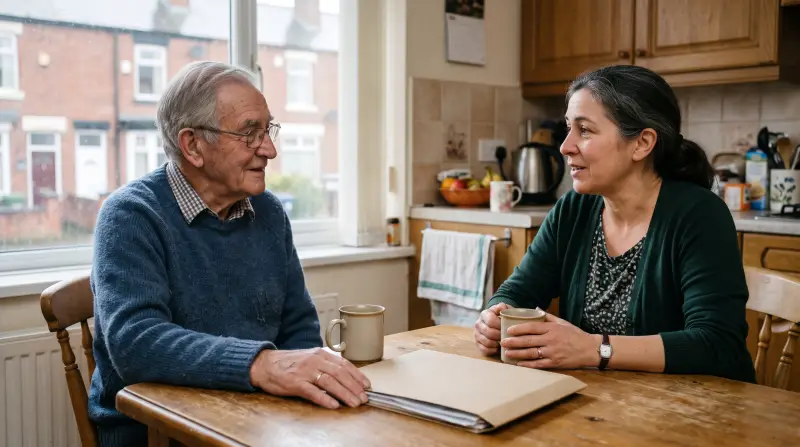
After her father’s fall last spring, a woman in Leicester started calling in every morning to help him wash and dress, and again at night to make sure he got to bed safely. A friend mentioned Attendance Allowance. She brushed it off: he owns his house outright and has a decent sum in the building society, so surely he would not qualify. That assumption is common, and it is wrong.
Attendance Allowance is not means-tested. It looks at the help someone needs, not at their bank balance.
What Attendance Allowance is for
GOV.UK describes Attendance Allowance as help with extra costs for people who have a disability or health condition and have reached State Pension age. The condition can be physical (including sensory disabilities such as blindness), mental (including learning difficulties) or a health condition, and it must be severe enough that the person needs help caring for themselves, or someone to supervise them for their own or someone else’s safety.
Three points are often missed. You do not need to have a carer in order to claim: the test is the help you need, not the help you get. It does not cover mobility needs. And you cannot get it alongside Disability Living Allowance or Personal Independence Payment. In Scotland, new claims go to Pension Age Disability Payment instead, and Northern Ireland has its own claim process through nidirect.
The two weekly rates for 2026/27
Attendance Allowance has two rates, which rose in April 2026:
- Lower rate, £76.70 a week: for people who need frequent help or constant supervision during the day, or supervision at night.
- Higher rate, £114.60 a week: for people who need help or supervision throughout both day and night, or whose medical professional has said they may be nearing the end of life.
Attendance Allowance appears on HMRC’s list of tax-free state benefits, so it is not counted as taxable income. If someone also gets Constant Attendance Allowance, their Attendance Allowance is reduced by that amount.
Savings, income and the means test that is not there
GOV.UK is explicit that your earnings and savings do not affect what you receive. A homeowner with a large pension and a widow living on the State Pension alone are assessed in exactly the same way: on how their condition affects their daily life.
That is what surprises many families, because so much other support for older people, such as Pension Credit or council help with care costs, is means-tested. Attendance Allowance sits apart from that.
It looks at the help someone needs, not at their bank balance.
The six-month rule
Under the standard rules, you must have needed the help for at least six months before you can get the allowance. That does not mean waiting six months to start thinking about it; it means the need has to have lasted that long. You also need to be in Great Britain when you claim and to have been here for at least two of the last three years, with exceptions for refugees and people with humanitarian protection.
Care homes are a common sticking point. If the local authority pays for your care, you usually cannot claim. If you pay all of your care home fees yourself, you can.
A faster route for people nearing the end of life
There is a separate way to claim if a doctor or other medical professional has said someone might have 12 months or less to live. The person must still be over State Pension age. The medical professional can complete form SR1 and either give it to the claimant or send it straight to the DWP. Claims under this route are paid at the higher rate, and no face-to-face assessment is needed.
Three claimants, one set of rules
| Claimant | Savings | Rate awarded | Weekly | Over 52 weeks |
|---|---|---|---|---|
| Joan, 81, help at night | £80,000 | Lower | £76.70 | £3,988.40 |
| Ray, 74, help through the day | £3,000 | Lower | £76.70 | £3,988.40 |
| Eileen, 88, help day and night | £20,000 | Higher | £114.60 | £5,959.20 |
Uses the 2026/27 weekly rates multiplied by 52. Awards depend on DWP’s decision about each person’s care needs; the rate shown is an assumption, not a prediction.
Joan has more than 25 times Ray’s savings, yet both receive the same weekly amount because both need a similar level of help. Eileen gets the higher rate because her needs run through the day and night, not because of anything in her finances.
How it can raise other help
Although Attendance Allowance ignores your means, other benefits take it into account in a helpful way. GOV.UK notes that getting it could mean extra Pension Credit, Housing Benefit or Council Tax Reduction.
The clearest example is Pension Credit. In 2026/27 the guarantee credit tops weekly income up to £238 for a single person or £363.25 for a couple, and it can include an extra amount for severe disability of £86.05 a week for people who get Attendance Allowance, subject to the household conditions DWP applies. Someone who was just over the Pension Credit line before an Attendance Allowance award can find they qualify afterwards. Our guide to why Pension Credit matters beyond the weekly top-up explains what else that can lead to.
How the claim works
- Apply online through the GOV.UK service, or print or request the paper claim form and send it to the Freepost address shown on GOV.UK. Applying is free.
- The Attendance Allowance helpline is 0800 731 0122, Monday to Friday, 8am to 6pm. If you request a form by phone and return it within six weeks, the claim starts from the date of your call.
- Within three weeks of claiming you should get a text or letter saying when to expect a decision, followed by a decision letter.
- If you disagree with the decision, you can ask for a mandatory reconsideration.
Many families help a parent fill in the form. If that help may extend to managing money later, a Lasting Power of Attorney is worth considering while everyone is well.
Who should look at this, and what to check
- Anyone over State Pension age who needs regular help with personal care or supervision, whatever their savings.
- Families who have ruled out a claim because a parent owns a home or has money put by.
- People already on Pension Credit, Housing Benefit or Council Tax Reduction, whose award could change if Attendance Allowance is paid; tell those offices once a decision arrives.
- Anyone whose needs have increased since an earlier award, who may need to report a change.
The point to hold on to
Attendance Allowance is decided on care needs alone. For 2026/27 it is £76.70 or £114.60 a week, tax-free, and paid regardless of savings or income. People nearing the end of life have their own, quicker route. Because the award can also feed into Pension Credit and help with housing costs, it is one of the first things worth checking when an older relative starts needing help at home.
Official sources
- GOV.UK: Attendance Allowance – What you’ll get: 2026/27 weekly rates, not means-tested, effect on other benefits
- GOV.UK: Attendance Allowance – Eligibility: Six-month rule, residence, care homes, Scotland
- GOV.UK: Attendance Allowance – Claiming if you’re nearing the end of life: 12-month rule, SR1 form, higher rate
- GOV.UK: Pension Credit – What you’ll get: Guarantee credit and severe disability amount
 Please note
We Are Apacc is an independent, sponsored information site published by PushImpact OÜ. We are not a government website and are not affiliated with the Department for Work and Pensions (DWP), HM Revenue & Customs (HMRC) or the Pension Service. This article is general information, not personal financial, legal or tax advice. Every amount is either a published official figure with its date or a clearly labelled illustration; none of them is a promise or an estimate of what you personally will receive or pay. The figures were checked on 28 October 2026 and can change. This site takes no applications, makes no decisions about entitlement and charges no fees. Never give your National Insurance number, bank details or Government Gateway or GOV.UK One Login credentials to a website you reached from an article. For your own case, use the official services on GOV.UK, including the Pension Service and HMRC contact pages.
Once a week, one money rule explained with its official source, from benefits and tax to savings and household bills, plus one date worth knowing. Free.